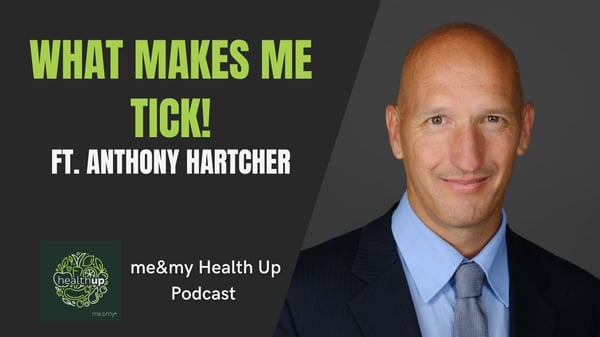
How much is too much? If you're someone who trains hard, works hard and keeps adding more to the pile, your body will eventually answer that question for you — and it rarely picks a convenient moment. Mine answered recently, and it wasn't subtle.
When your body sends the invoice
I recently went in for a double hernia operation. Not a pleasant thing to have to do, but it needed doing — and I have no doubt about where it came from. Years and years of training, working, pushing and pushing and pushing, without ever really finding the balance between effort and recovery.
For most of my adult life my instinct was the same: I needed to do more, push more, achieve more. What I never built in with the same discipline was the coming back — the restoring, the relaxing, the deliberate pause that lets you go forward again in a stronger state rather than a more depleted one.
So the surgery was, in a sense, a feedback mechanism. My body's way of saying: you haven't supported me enough. And I've taken that on board properly. Over the last few years I've embraced a far more balanced approach to my own health and wellbeing, and I want to save you the version of this lesson that involves a hospital.
Maximum growth sits at the border of challenge and support
There's a line from Dr John Demartini that I come back to constantly: maximum growth occurs at the border of challenge and support.
That's a precise idea, and it's worth sitting with. Growth doesn't come from challenge alone — challenge without support is just erosion. And it doesn't come from support alone either; comfort without challenge produces nothing. Growth lives on the line between the two, where the demand you place on yourself is matched by the recovery, rest and nourishment you give yourself.
Looking back honestly, I was badly out of balance on that line. Plenty of challenge. Nowhere near enough support. And when you hold that position long enough, the body doesn't negotiate — it simply presents the bill.
Why extremes and fads fail you in the long run
This is also why I'm cautious about health trends that run on extremism. Take intermittent fasting with a 16:8 window. It has genuine benefits, and for some people in some seasons it's a useful tool. But the question I always ask is: is it healthy long-term, for you, in your actual life?
Push any protocol to the edge indefinitely and you start accumulating costs. It might be nutritional — you simply can't fit adequate nutrients into a shrinking window forever. It might be social, which people underestimate badly. If you're sitting at a table with people you love, not eating, not sharing the meal, not present in the moment because the clock says the window is closed, that's a real cost to your wellbeing even if your blood markers look tidy.
The same logic applies to training volume, work hours, step counts, cold exposure, caffeine — anything you can turn into a number and then compete with yourself over. The protocol isn't the problem. Pushing the limits of it, permanently, with no accompanying support, is.
Your body is always giving you feedback
Here's the encouraging part: your body tells you long before it has to shout. It gives you feedback constantly about whether you're going too far — niggles that don't resolve, sleep that stops restoring you, motivation that quietly disappears, a short fuse with the people you care about, performance that plateaus no matter how much harder you work.
The skill isn't toughness. The skill is listening, and then actually adjusting. I'd been receiving that feedback for a long time and treating it as something to push through. The lesson I've genuinely learned is to treat it as information.
I'll still exercise — of course I will. But I'm not going to do extremism anymore. I'm not going to drive my body past its limits and then deny it the support it needs to recover and rejuvenate.
Balance isn't the opposite of performance — it's how you get it
I want to be clear about something, because "find balance" can sound like a softer, lesser goal. It isn't.
You will get better athletic performance when you find the balance between your training sessions and your recovery. That's not a consolation prize for easing off; it's how adaptation works. Training provides the stimulus. Recovery is where the adaptation actually happens. Get the ratio right and you reach your optimal performance — in outcome and in results. Get it wrong in the direction of more, always more, and you're training hard for diminishing returns, then injury.
So yes, you need challenge in your life. Keep it. Then go and find the equivalent support, because that's the condition for thriving rather than merely surviving.
Key takeaways
- Match every increase in challenge with an equivalent increase in support — rest, sleep, nutrition, downtime, connection.
- Treat your body's signals as information, not obstacles. Persistent niggles, poor sleep and flat motivation are feedback.
- Be sceptical of any protocol that only works at its extreme, and ask whether you could sustain it for years rather than weeks.
- Count the social and emotional costs of a health regime, not just the physical metrics.
- Build recovery into your training plan deliberately — adaptation happens during rest, not during the session.
- Aim for moderate and consistent over extreme and brittle. Consistency compounds; extremism breaks.
This is exactly why I take a holistic view with the people I work with at me&my wellness. It's never just the training programme or just the eating plan — it's the whole picture of load and recovery across your body, your mind, your work and your relationships. My own detour through the hospital system left me feeling disempowered and without control, and I'd much rather help you live proactively than have you learn this the way I did.
Want to go deeper on this? Book a free 30-minute discovery call with Anthony at meandmywellness.com.au