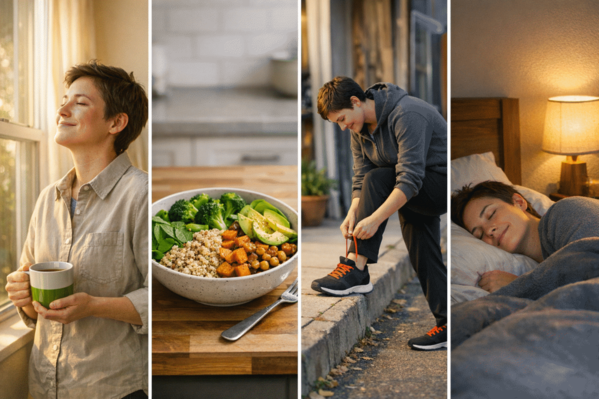
If you've ever lain in bed staring at the ceiling, running through tomorrow's to-do list, you'll know that trying to fix sleep at 10pm is mostly too late. By then, the decisions that shape your night have already been made.
That's the single most useful thing I can tell you about sleep: it isn't a night-time activity. Good sleep is the result of what you do from the moment you wake up. So let's walk through the day in order.
Start with morning light
The first thing on my list of sleep tips has nothing to do with your bedroom. Get outside in the morning and get some sunshine on you.
That early light does something remarkable. It tells your cells and your organs — quite literally — that it's daytime and it's time to do daytime jobs. It resets your internal clock. It switches on the functions you want running during the day: digestion, energy production, the alertness that lets you be productive.
You don't need to overthink the dose. Step outside with your coffee. Walk to get the paper. Eat breakfast near a window that's actually open to the sky. The point is that your body gets a clear, bright signal early, so that twelve to fourteen hours later it knows the day is done.
Be strategic about caffeine
I'm not going to tell you to give up coffee. I will tell you to be deliberate about how much and, more importantly, when.
The guidance I use with clients is around two milligrams of caffeine per kilogram of body weight. So if you weigh about 70 kilograms, that's roughly 140 milligrams — which, depending on how it's made, lands at about one to two cups of coffee. And I'd have all of it before midday.
The timing matters more than most people realise, because caffeine lingers in your system for far longer than the alert feeling lasts. An afternoon coffee can still be quietly interfering with your sleep architecture at midnight, even if you fell asleep without trouble. If you want one easy experiment this week, make it a hard cut-off at lunchtime.
Build sleep pressure through movement
Being active during the day creates what we call sleep pressure — the accumulating drive to sleep that makes falling asleep feel easy rather than effortful.
A good proxy to aim for is around 10,000 steps a day. Ideally you want to be above 7,500. And this isn't about carving out a punishing gym session; it's about not sitting still for ten hours. Get up, move about, take the longer route, walk while you're on calls. Structured exercise on top of that helps further, but the baseline movement is what builds the pressure.
What you're aiming for is to arrive at the end of the day genuinely, pleasantly tired — so your body can get on with the repair work it does while you're asleep.
Get the evening timing right
Now to the evening, where a few small timing choices make a real difference.
Finish eating at least two hours before bed. You don't want to go to bed on a full stomach, but you don't want to go to bed starving either — there's a happy medium, and it's worth finding yours. Ease off liquids in the evening too, simply because a full bladder at 3am will fragment an otherwise good night.
And then there's alcohol, which I know is on your mind. Here's the honest picture: alcohol may help you fall asleep, but it damages the quality of the sleep that follows. It makes you wake more often through the night and it blunts your deep sleep. If a drink with your partner or family is part of how you unwind, my suggestion is to keep it to one standard drink a night.
Empty your brain onto paper
This is the one I'd most like you to try, and research does support it as a wind-down practice.
We spend the day holding an enormous amount in our heads. In the evening, the job is to unload it. Get a notebook and write it out: what's on your mind, the to-do list, the tasks you need to tackle tomorrow, how you're actually feeling. Getting it out of your brain and onto paper means your mind no longer has to keep rehearsing it to avoid forgetting it.
But don't finish there, on a page of unfinished business. Close with something good — a bit of gratitude journaling. What went well today? What are you looking forward to tomorrow? That shift into appreciation is genuinely relaxing, and it tells your brain that everything is okay. That's the message you want to fall asleep on.
Dim the light and actually relax
Two hours before bed, start bringing the light down. Screens, devices, bright overhead lighting — dim it all. Darkness is the signal your body needs to start producing melatonin, your sleep hormone. If you wait until you're already in bed, you've compressed that process into nothing.
Just as importantly, protect the evening from stress. Don't do work late. Don't have the difficult conversation at 9pm. Those things flip your nervous system into fight-or-flight, and you end up with adrenaline and cortisol circulating when you want the opposite. High cortisol actively suppresses the sleep hormones you're trying to produce.
So do things you enjoy instead. Read. Stretch. Talk about something pleasant. Let the evening be gentle on purpose.
Key takeaways
- Get outside for natural light early in the morning to reset your internal clock for the day ahead.
- Cap caffeine at roughly 2mg per kilogram of body weight, and finish it before midday.
- Aim for 10,000 steps a day (and at least 7,500) to build the sleep pressure that makes falling asleep easy.
- Stop eating about two hours before bed, go easy on evening liquids, and keep alcohol to no more than one standard drink.
- Journal before bed — unload your to-do list and your thoughts, then finish with gratitude.
- Start dimming lights and screens two hours out, and keep work and hard conversations out of the evening.
None of these sleep tips is dramatic on its own. That's rather the point. The holistic approach I take at me&my wellness is built on exactly this: a handful of small, consistent choices across your whole day — light, food, movement, mindset — that compound into how you feel. Sleep is where all of those threads meet, which is why it's such a good place to start. Pick two from the list above, do them for a fortnight, and see what shifts.
Want to go deeper on this? Book a free 30-minute discovery call with Anthony at meandmywellness.com.au